
Hitting the Opus weekly limit in Claude Code? Meter it on its own
Anthropic meters some plans' weekly usage per model as well as overall. Notchmeter shows every per-model weekly limit Anthropic reports for your account, Opus, Sonnet, Fable and whatever comes next, as its own meter with a pace tick and its reset, and when one model is nearly gone while another has room it says so in one line: Opus weekly is 91%. Sonnet is 34%. Switch models, not tools.
macOS 15 or later · Apple silicon or Intel · no account, ever
What Notchmeter shows for the per-model limits
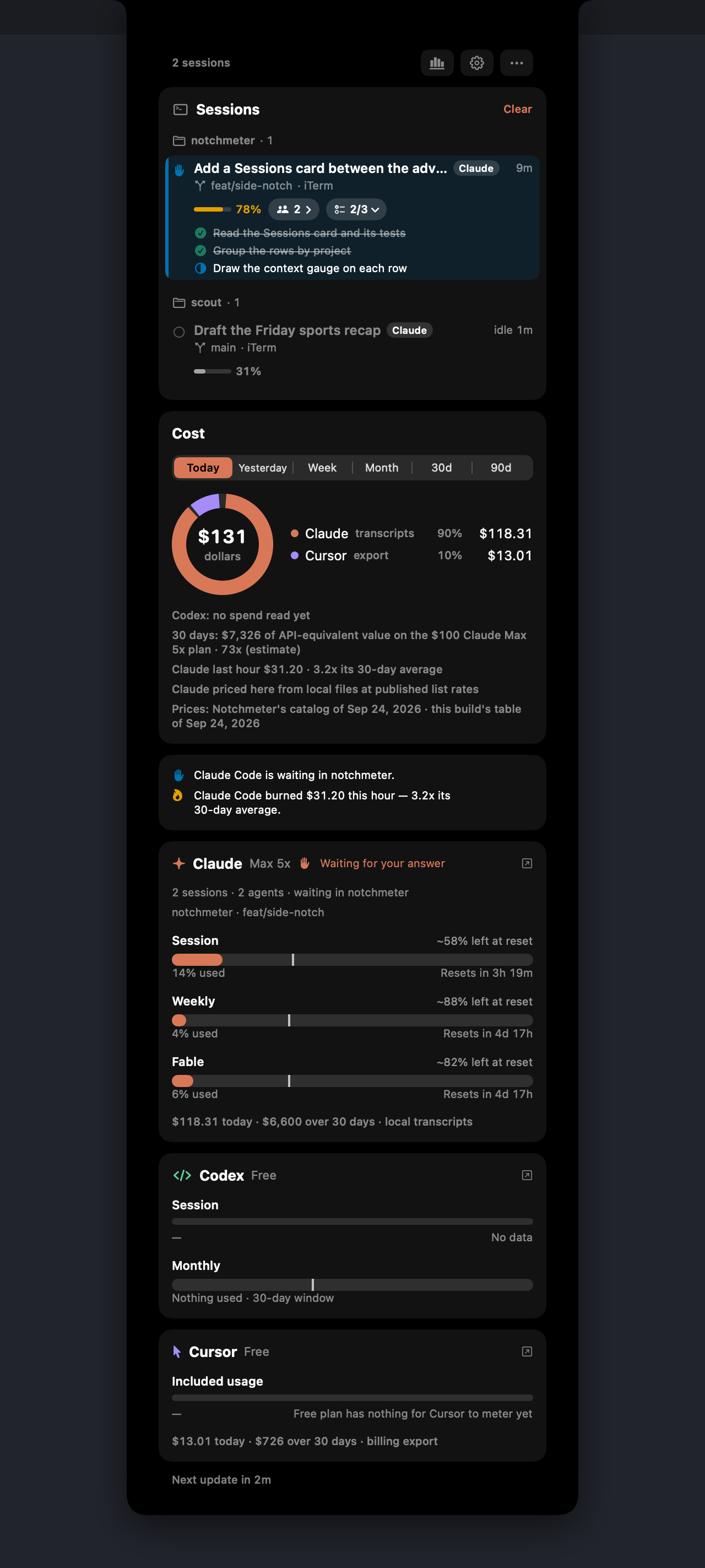
The render on the right shows a Fable weekly meter under the Session and Weekly ones; an account with an Opus limit gets an Opus meter in the same place, and a Sonnet one beside it.
- One meter per model Anthropic reports a weekly limit for, named for the model, with the used share, a pace tick, a projection (“~82% left at reset”) and the reset as a countdown or an exact time.
- All models: one window standing for the per-model ones, tagged inferred and captioned “Combined from the windows below”, because it is derived in the app rather than read. Where Anthropic's own weekly window covers the same period and reset as every per-model window and reads no lower than any of them, its figure is adopted exactly and never recomputed; otherwise the figure is the highest of the model windows, never their mean, and the reset the soonest, so it cannot show headroom that does not exist.
- The week's price: “$1.58 per 1% of weekly” on the Cost card, the week's spend from this Mac's transcripts divided by the weekly window's used share from the same reading, so you can see what a point of the cap is worth in API terms.
- Which model spent it: the range's models ranked by cost, and the Usage Dashboard's “By model” bars.
- The notifications: on track, behind, and run-out within an hour, per window, so the Opus meter warns on its own crossing.
Where the per-model limits come from
They are Anthropic's own figures, read from the one endpoint that carries them.
| Figure | Source | Notes |
|---|---|---|
| Opus, Sonnet, Fable… weekly | GET https://api.anthropic.com/api/oauth/usage: the limits[] entries of kind weekly_scoped, and the older seven_day_opus and seven_day_sonnet fields | The status line carries only the session and weekly windows, so beside a fresh status line the endpoint is still read every thirty minutes, for these alone, and its answer is laid under the status line's figures. |
| All models | Anthropic's own weekly window, adopted exactly where it covers the same period and reset as every per-model window and reads no lower than any of them; otherwise the highest used share of the per-model windows above, with the soonest reset | Derived in the app rather than read from the endpoint, so tagged inferred either way (CombinedWindow.swift). No money is added up across it. |
| $ per 1% of weekly | The week's cost from this Mac's transcripts (the week starts where the live weekly window started) over the weekly window's used share from the same reading | An estimate at API list price, not a bill. |
| Tokens on each side of the tokenizer line | Anthropic's pricing page: Claude 4.7 and later, and the Mythos and Fable line, tokenize with a vocabulary that yields about 30% more tokens than Claude 4.6 and earlier for the same text | A model that cannot be placed, a bare “Opus” with no version, is placed on neither side and nothing is said. |
On 2026-09-14 Anthropic changed what the weekly window measures while its used percentage went on reading the same. Notchmeter records that as a boundary row in its drain log, and the session-metering norm it compares today against is floored at that date, so a week that began under the old rule is never taken as the norm for the weeks after it (The weekly-cap boundary).
None of this is inferred from cost. A per-model meter exists only where Anthropic reports the limit; an account whose endpoint reports none has none, and the Cost card's by-model breakdown stays a breakdown of spend. Where the figures come from and how they are merged with the status line is in Where Claude’s windows come from.
Switch models, not tools
The Advice strip's lines for a per-model limit, each a pure function pinned by tests.
Questions
Which per-model limits does Notchmeter show?
Whichever ones Anthropic's usage endpoint reports for your account: the entries of kind weekly_scoped, which today name models such as Opus, Sonnet and Fable, plus the older seven_day_opus and seven_day_sonnet fields where a payload still carries them. An account with no per-model limit has no per-model meter, and an API-key setup has no plan windows at all.
Why is the Opus meter not fed by the status line?
Because Claude Code's status line carries only the session and weekly windows. Notchmeter takes those from the status line while it is fresh, and reads the usage endpoint every thirty minutes beside it for the per-model limits and extra usage, laying the answer under the status line's figures rather than over them. Where Claude’s windows come from has the order and the timings.
When does it tell me to switch models?
When a per-model window is 85% used and another model, or the overall weekly window, still has 40% left. The line names both figures, so you can judge it yourself: “Opus weekly is 91%. Sonnet is 34%. Switch models, not tools.”
Does switching models change how many tokens the same work takes?
It can. Anthropic's pricing page says Claude 4.7 and later, and the Mythos and Fable line, tokenize with a vocabulary that yields about 30% more tokens than Claude 4.6 and earlier for the same text. When the two models an advice line names straddle that line, the line says which one counts more tokens; a model it cannot place is placed on neither side and nothing is claimed.
How much does one per cent of the weekly limit cost?
The Cost card's Week range says, for example, “$1.58 per 1% of weekly”: the week's spend from this Mac's transcripts, priced at Anthropic's list rates, divided by the weekly window's used share from the same reading. It is the API-equivalent value of a point of the cap, not a bill, and it covers this Mac's sessions only.
Does the Opus limit reset with the weekly window?
Each per-model window carries its own reset moment in Anthropic's reading, and Notchmeter shows that moment on that meter. It does not assume the per-model resets coincide with the weekly one; it shows what Anthropic reports for each.
Install it
macOS 15 Sequoia or later, Apple silicon or Intel. Signed, notarised, and it updates itself. Free forever, MIT licensed.
Notchmeter is a Mac app. There is no Windows or Linux version; if you want a Windows one, the Windows issue is where to say so. How every figure is built, with its source and its date: docs/accuracy.md.